
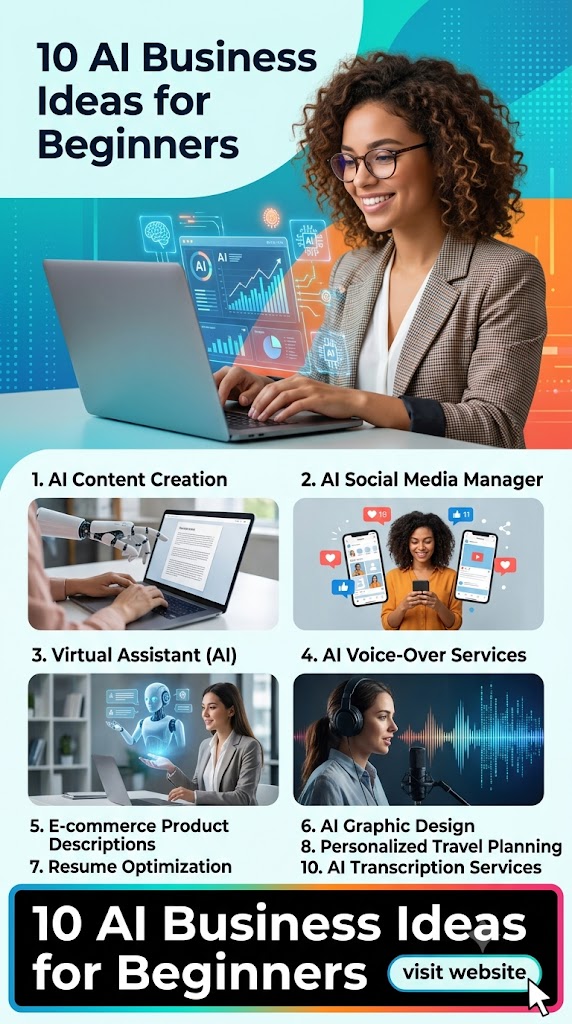
Your 2026 Blueprint
The question for small business owners in 2026 is no longer whether to use AI, but where to start . With 42% of small and medium-sized enterprises now actively using AI tools, the opportunity for beginners to launch profitable AI-powered businesses has never been more accessible . This guide outlines ten actionable AI business ideas, complete with pricing models and practical steps to help you get started—no coding experience required.
The Opportunity: Why AI is Ripe for Beginners
Several converging trends make 2026 the ideal year for launching an AI business. The investment landscape is broadening, allowing smaller, agile companies to find specialized niches and launch profitable AI ventures . This shift is partly because the “AI ecosystem is structurally different” from earlier tech waves. Industry giants like Google, Meta, Microsoft, and OpenAI have already built the infrastructure, making powerful AI models accessible via APIs and subscription services . This means you don’t need to build a foundation; you just need to build on it.
Furthermore, the rise of “vibe coding” and no-code AI platforms has dramatically lowered technical barriers. These tools allow non-technical founders to build functional products, automate complex workflows, and even create software companies without writing traditional code . This has fueled a boom in one-person companies (OPCs), with China alone registering 2.86 million new OPCs in the first half of 2025—a 47% year-on-year increase . With AI handling tasks that previously required entire teams, one person can now operate with the output of a much larger organization .
10 AI Business Ideas for Beginners
1. AI Automation Micro-Agency
Small business owners are eager to save time but often lack the technical knowledge to implement AI tools. This creates a perfect opportunity for an AI automation micro-agency. These businesses don’t build new AI models; instead, they connect existing tools to replace manual workflows .
What you do: You set up automated systems for lead capture, appointment booking, customer follow-up messages, and internal task routing. For example, you could create a workflow for a clinic where patient inquiries are handled automatically without staff intervention .
Pricing Model: Entry-level packages often focus on one or two workflows, while higher tiers cover multiple systems . You can charge a setup fee plus a monthly retainer . This model has “moderate startup costs and recurring revenue,” making it attractive for solo founders .
2. AI-Powered Content Repurposing Studio
Creating consistent content across multiple platforms is a major challenge for creators and brands. An AI-powered content studio addresses this by turning long-form material into multiple formats without increasing workload .
What you do: You take existing content—like podcasts, webinars, or recorded talks—and use AI tools to extract short videos, draft social media posts, write blog articles, and prepare newsletters . You are a “central production hub rather than a creative agency” . The method is often called “content multiplying.” One creator described this workflow: “Creating YouTube content used to require four different tools at $143/month. My workflow went from 6 hours per video to 2.5 hours, and I’m saving over $1,700 a year” .
Pricing Model: Most clients pay a monthly subscription based on volume. Packages scale with the number of videos processed and the range of formats delivered .
3. AI-Powered Lead Management Service
Missed inquiries are a hidden cost for many businesses. Calls go unanswered, messages sit unread, and leads are lost. AI-based lead management services close this gap .
What you do: You deploy chat tools, SMS systems, and messaging bots that respond to inquiries at all hours. They answer common questions, qualify leads, and book appointments directly into calendars. When human input is required, the system routes the lead without delay . As one industry commentary notes: “AI-backed support systems are cutting the time to get a response down to zero and cutting the costs involved in operations at the same time” . The value proposition is simple: “no lead is ignored” .
Pricing Model: A setup fee is combined with a monthly service charge, reflecting the ongoing role of the system .
4. AI Education and Workforce Training Consultancy
While many organizations have access to AI tools, staff adoption often remains limited. An AI training consultancy helps teams integrate AI into their daily work .
What you do: You design workshops, role-specific guides, and internal playbooks. Sessions cover prompt writing, task automation, data handling, and boundaries around sensitive information. Follow-up support may include office hours and workflow reviews . As one expert put it, these consultants “sell understanding and behavior change” .
Pricing Model: Engagements are usually priced per workshop or program, with some firms opting for quarterly retainers. A single contract can cover your startup costs .
5. AI Output Auditing and Safety Consulting
As AI systems move into live environments, concerns around accuracy, bias, and compliance are growing . AI output auditors focus on reviewing what systems produce, rather than how they are built.
What you do: Your work includes checking outputs for factual errors, tone alignment, and risk exposure. In regulated sectors, you may map outputs against industry rules and internal policies. You document where human review is required and where automation should stop . This role addresses a concern industry leaders have raised about low-quality AI output and its impact on trust and decision-making . This niche is attracting professionals from compliance, legal, finance, and communications backgrounds .
Pricing Model: The service is often delivered through one-off audits or ongoing retainers .
6. Personalized GPT Ecosystem Builder
Many entrepreneurs and CEOs want AI to streamline their workflows but don’t know how to set up custom systems. Building personalized GPT ecosystems is a high-value, beginner-friendly business idea .
What you do: You collect your client’s workflows, goals, tone, and preferences. You then create “master prompts” for different business contexts, build “system prompts” for repeatable outputs, and set up custom GPTs tailored to their role. Finally, you generate an SOP that teaches them how to use everything .
Pricing Model: This is one of the most profitable AI business ideas. You charge a setup fee plus a monthly subscription for ongoing maintenance as AI platforms update. As expert Dan Martell notes, clients will pay for speed and simplicity .
7. No-Code AI Product Builder
The no-code AI boom is fueling a new category of entrepreneurs who use prompts and APIs—not traditional code—to build tools for specific communities or industries .
What you do: You could build a chatbot therapist trained on dialectical behavior therapy, a podcast scripting assistant, an immigration law bot, or a real estate onboarding tool—the possibilities are vast. Using platforms that simplify model customization, hosting, and deployment, you can launch a functional product in days or hours . With “under $100 in infrastructure costs, creators can launch AI products that deliver real value, often through subscriptions or metered usage” .
**Pricing Model:** Many of these projects become profitable with just a few hundred users, monetizing through paid access, integrations, or AI model marketplaces . Some creators sell their successful products for substantial sums. For instance, Base44, founded by a non-technical creator who used AI to build a no-code development platform, sold to Wix for $80 million in cash .
8. AI Website Builder
AI website builders like Framer AI and Lovable allow anyone to create fast, beautiful, responsive websites without writing code . This is an excellent entry point for beginners.
What you do: You take a client intake form, submit the brand details and style preferences to an AI tool, let it generate the first version of the site, polish the layout and design, send the draft to the client, and apply revisions using AI . This process opens multiple income opportunities, from complete website builds and landing pages to email automation setups and monthly maintenance retainers .
Pricing Model: Because businesses constantly need updated digital assets, this becomes a recurring revenue model .
9. AI-Powered Workshop Creator
If you have achieved any meaningful result—in marketing, productivity, hiring, or any other field—you can turn it into a workshop or training program using AI .
What you do: You use AI to generate a full workshop outline, lesson scripts, slides, exercises, and even a sales page. To build your workshop, you can “ask ChatGPT to interview you like a beginner, answer the questions naturally, and then convert the answers into a step-by-step workshop” . Once recorded, these become digital assets you can sell repeatedly.
Pricing Model: Workshops are sold as digital products, creating a source of passive income .
10. AI-Powered Accounting and Financial Analysis
Balancing the books is a task many small business owners dread. AI-powered accounting tools now use machine learning to categorize transactions, flag anomalies, and forecast cash flow based on historical data . This creates an opportunity to offer a specialized service.
What you do: You can use tools like QuickBooks, Xero, or Dext to help businesses automate their financial management. Claude for Small Business, for instance, integrates directly with tools like QuickBooks and PayPal, allowing you to “pull the cash position, reconcile it against PayPal settlements, rank overdue invoices, and draft a reminder email for each one”—all in about twelve minutes . For businesses without a dedicated finance team, “this kind of automated insight can be the difference between making an informed decision and flying blind” .
Pricing Model: You can offer your services as a fractional CFO, charging a monthly retainer. As one source notes, one such workflow is the equivalent of what “you’d pay a fractional CFO $800 a month to run” .
Key Considerations for Your AI Business
The Importance of Human Judgment
While AI is a powerful tool, it’s essential to treat its outputs as drafts, not final products. Always check numbers, names, and claims before acting on or sharing AI-generated content . As Timothy Gauci, Design and Diplomacy Director, noted: “AI is a productivity and thinking accelerator – not a substitute for professional judgement” . Maintaining a human review step is critical, especially for higher-risk outputs .
Data Security and Privacy
Data security is a major concern for business owners. In fact, research found that half of small business owners named data security as their single biggest hesitation about AI . To mitigate this, avoid pasting sensitive customer or business information into free AI tools, which may use your conversations to improve their model . Always read the privacy settings . Tools designed for business use often have policies where Anthropic “doesn’t train on your data by default on Team and Enterprise plans” .
Start Small and Scale
The biggest mistake small businesses make with AI is trying to adopt too much at once . Start with a single, time-consuming task and find a tool that solves it well. Get comfortable with it, measure what it’s saving you, and then build from there . This approach is far more likely to deliver lasting results than a sweeping technology overhaul .
The Cost is Lower Than You Think
Many AI tools aimed at small businesses offer free tiers or affordable monthly plans—often less than the cost of a few hours of staff time . For example, Zapier’s free tier covers 100 automated tasks a month, and ChatGPT and Claude both offer free access with paid plans starting around $20 a month . The real cost of not using AI is often greater: time lost to manual tasks, opportunities missed, and decisions made with incomplete information .
Conclusion: Your AI Future Starts Now
The barriers to entry for AI-powered businesses have never been lower. Whether you choose to build a micro-agency, a content studio, or a no-code product, the key is to start small, focus on solving a real problem for a specific audience, and leverage AI as a tool to enhance your own skills and judgment. As one expert aptly put it, in the “human plus AI” model, “the human remains the core competitive factor” . The opportunity is real, the tools are accessible, and the time to start is now