
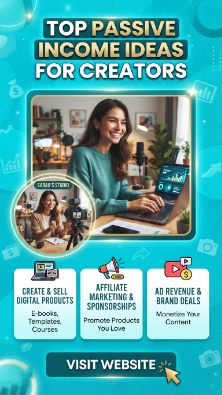
The creator economy has evolved far beyond the days when “making it” meant landing a single brand deal or amassing millions of followers. In 2026, the creator economy crossed $250 billion in value, and analysts at Goldman Sachs project it could hit $480 billion by 2027. More than 200 million people worldwide now create content for a living or as a serious side income .
Yet here’s the reality check: over 50% of creators earn less than $15,000 a year. The difference between those who struggle and those who thrive almost always comes down to one thing: how many income streams they have . People who rely on a single revenue source are the most vulnerable. You lose a brand deal, an algorithm shifts, or a platform cuts its payout rates, and your income collapses.
The creators who build real financial stability spread their earnings across three to four sources at a minimum . This article explores the most effective passive income strategies for creators in 2026, organized by the type of creative work you do. The common thread? Each idea allows you to create once and earn repeatedly, breaking the cycle of trading time for money.
Understanding Passive Income for Creators
Before diving into specific ideas, let’s clarify what passive income actually means in the creator context. Despite what the name might imply, there is always some work required to generate passive income. Instead of day-to-day duties, though, the bulk of the effort is done up front. And if you do it right, you can watch money roll in over the long term .
The most successful creators treat their content like a business. They diversify across income streams, build their email list, own their customer relationships, and protect the infrastructure they work on . You don’t need to do all of this at once. Start with what fits your content and your audience. Add one new revenue stream every few months. Over time, you build something that no single algorithm change or platform decision can take away from you .
Digital Products: Create Once, Sell Forever
Selling digital products is arguably the smartest move a creator can make. You create the product once and sell it an unlimited number of times. You don’t have to worry about shipping costs or inventory. And the profit margins reflect this beautifully—most digital products operate at 80% to 95% profit margins, compared to 30% to 50% you’d typically see in physical product businesses .
E-books and Guides
Self-publishing a book is easier than ever. Ramit Sethi, host of Netflix’s “How to Get Rich,” notes that while there’s certainly an up-front time investment, “books can continue generating income long after they’re published, creating a steady stream of passive revenue” . Amazon’s Kindle Direct Publishing lets authors sell books and earn up to 70% per download, with no publisher needed . You don’t need a bestseller—even niche content can generate steady income over time .
The wealth coach Halle Eavelyn puts it bluntly: “The publishing industry can take up to two years to go to print and keeps a lot of its doors closed; meanwhile, self-publishers are cashing checks. 2026 is prime time for journals, planners and even ‘low-content’ books like coloring books. You don’t need to be Hemingway—just organized” .
Templates, Presets, and Toolkits
If you’ve developed templates, icons, fonts, or illustrations to save yourself time in your creative process, those could be valuable to others who lack the skill to create them . Think Notion dashboards, Canva kits, spreadsheets, or automation libraries. Create it once, list it everywhere—Etsy, Creative Market, and Gumroad .
One artist found that shops with 150 to 200 listings average between one and three sales per day . The key is building a diverse catalog that people can choose from.
Online Courses
The e-learning market reached $314 billion in 2024 and is expected to grow to $615 billion by 2029 . Creating courses lets you turn what you know into a passive income stream. Whether you teach business skills, marketing, design, or even parenting hacks, there’s someone out there who needs to learn what you know and will pay for it. With platforms like Teachable, Kajabi, Thinkific, and Skillshare, you can record your course once and sell it repeatedly .
Niche courses perform particularly well. Instead of a generic “Freelance Writing 101,” consider something like “How to Write Case Studies That Convert” . The more specific and actionable, the better.
AI-Assisted Content Creation
Artificial intelligence has created new opportunities for creators fluent in using the technology. Consider creating and selling AI prompts or prompt packs—curated effective prompts for marketers, coders, or designers . You can also build a custom GPT that automates annoying tasks people have mentioned to you or you’ve discovered via your own research. One tool can help hundreds of clients who share the same pain point .
AI tools like ChatGPT-5, Descript, and Notion AI represent the new workforce. You can automate scripts, thumbnails, editing, and turn YouTube and TikTok into 24/7 revenue streams . The key is repurposing every long-form video into 3-5 micro-posts for multiple platforms—that’s content multiplication through automation .
Royalties and Licensing: Get Paid for What You’ve Already Made
Royalties are a time-honored passive income strategy for creators. Writers, artists, and musicians monetize their work long after it’s finished . Here’s how different types of creators can tap into this stream.
For Musicians and Audio Creators
Sites like BeatStars or AudioJungle are good places to sell beats and loops . Musicians who want to sell full songs can use services like Bandcamp and LANDR to market directly to their potential fanbase . If you have contacts in the influencer world, consider selling a license of your music to serve as soundtracks for YouTubers, podcasters, and other influencers .
For Photographers and Videographers
Search interest in selling stock photos online saw a 151% jump from 2023 to 2024 . As with digital prints, the larger your portfolio, the better your chances of finding a buyer. Pay attention to trends—some stock photo companies list subjects or themes that are particularly marketable on their sites, and holiday-themed shots do well when timed right .
The video footage market has even higher per-license values ($30 to $500 per clip for premium footage) and less competition than the photography market, making it an attractive entry point for videographers with drone footage, time-lapse, or specialty content .
For a portfolio of 5,000 images with an average of 10 downloads per image per month, you could generate 50,000 downloads and $12,500 to $25,000 per month . The key variable is understanding what stock buyers need and producing it deliberately rather than uploading existing work .
For Writers
Beyond self-publishing books, writers can also license articles, essays, or short stories to publications or content platforms. Every piece of content you create has potential residual value if you structure your rights appropriately.
Memberships and Subscriptions: Predictable, Recurring Revenue
More creators are shifting toward recurring revenue through memberships. Platforms like Patreon, YouTube Memberships, and Substack let your audience pay a monthly fee in exchange for exclusive content .
Subscriptions grow slower than ad revenue, but they are far more stable. A creator with 2,000 paying subscribers at $10 per month earns $20,000 monthly before any other income. That is predictable money that does not depend on a single viral post. People who move toward subscription models often describe it as the first time their income felt reliable .
Paid Micro-Communities
Forget going viral. Niche is the new scale. Start a paid community around something ultra-specific—like “AI Tools for Artists” or “Digital Nomads with Kids.” When you own a niche, you own loyalty—and loyalty compounds into income .
Email Courses
An email course is like a YouTube course, but delivered through email. The advantages include the ability to use multiple media (images, recipes, instructions, animations) and the opportunity to personalize content for each subscriber. While personalizing your course may be time-consuming at first, over time you’ll get to know your students’ typical needs, making it easier to create a unique experience efficiently .
Affiliate Marketing: Earn While You Recommend
Affiliate marketing is one of the most accessible income streams you can start today. People recommend a product and share a buying link with their audience. You get a commission every time someone buys through your link .
Affiliate marketing works on trust. Your audience already follows you because they value your opinion. When you recommend something you genuinely use, people listen. Creators in tech, fitness, beauty, and personal finance do especially well here because their audiences actively look for product recommendations . According to data from 2026, affiliate-driven creator partnerships are one of the fastest-growing deal structures brands are adopting .
How Different Creator Types Perform
The creators seeing the highest returns are those in high-intent verticals—where the audience already has purchase intent and is looking for a trusted recommendation before they buy. Finance YouTubers promoting fintech, insurance, and trading apps can earn ₹500–₹2,000 per lead (very high potential). Tech reviewers earn 4–12% per sale on electronics and SaaS products. Lifestyle bloggers earn 8–15% per sale on fashion, beauty, and home décor items .
The Compounding Effect
The real power of affiliate marketing comes from its compounding nature. Creators can publish blog posts, create Pinterest pins, or Reddit guides that link to tools they already use. Once traffic builds, the content ideally keeps earning . A single well-ranked article in a high-commission niche (web hosting, VPN software, financial products) can generate $1,000 to $10,000 per month indefinitely .
Smart creators diversify their affiliate income across multiple touchpoints—YouTube reviews with links in descriptions, Instagram Reels with a link-in-bio tool, SEO blogs that rank on Google, WhatsApp and Telegram groups, email newsletters, and curated creator shops . They’re turning every piece of content into a potential revenue stream.
Getting Started
You can start with Amazon Associates or ShareASale, tuck links into posts or even your email signature, and watch it grow . Even a newsletter with 5,000 engaged subscribers can outperform a creator with 100K followers when it comes to affiliate conversions .
Platform Ad Revenue: The Base Layer
Every major platform now shares ad revenue with creators. YouTube’s Partner Program pays creators based on views and watch time. Similar programs exist for TikTok, Instagram, and Facebook .
Ad revenue is the best source of income if you create a high volume of content. It works for any niche—finance, education, technology, lifestyle, and entertainment. However, different niches earn different rates. Finance and business content earns $5 to $30 CPM (revenue per 1,000 views), while entertainment content earns $1 to $5 CPM .
Important note: You should treat ad revenue as a base layer, not your main income. Platforms change their algorithms and payment structures regularly, so people who rely on ad money alone get burned .
The YouTube Strategy
A YouTube channel with 100,000 subscribers in a high-CPM niche can generate $3,000 to $10,000 per month from ad revenue alone, with no additional work required once the videos are published . The compounding effect is the specific economic advantage of content creation—a YouTube video published in year one continues generating views and revenue in years three, four, and five. A blog post that ranks on the first page of Google for a valuable search term generates traffic daily without any ongoing effort .
Print-on-Demand: Creative Products Without Inventory
Print-on-demand is a low-risk way to turn your creativity into passive income. You can design T-shirts, mugs, journals, tote bags—whatever fits your niche. You upload those designs to platforms like Printful or Redbubble, and whenever someone places an order, the product is printed and shipped automatically. You never have to deal with inventory or shipping .
AI tools make this even more accessible. Anyone can “whip up a funny T-shirt or a sassy coffee mug and have it shipped straight to someone’s door. The beauty is that you never touch inventory. In 2026, people love buying niche, personal stuff—so make five designs on Canva, upload to Printful or Redbubble, and let TikTok do its thing” .
Visual artists can also sell digital prints through Etsy, Gumroad, or Creative Market, then extend their income potential by expanding offerings beyond prints to shirts, tote bags, and more through dropshipping companies .
User-Generated Content (UGC): The Overlooked Opportunity
UGC is a fast-growing opportunity that many creators overlook. Brands pay you to produce content they use on their own channels, not yours. You do not need a large personal following. You need the skill to create content that looks and feels authentic .
This has partially decoupled creator income from follower count. A creator with 5,000 followers may still monetize effectively if they produce strong converting content . This is particularly appealing for creators who excel at production but haven’t built a massive audience.
Building Apps, Plugins, and Software
For creators with technical skills, building and selling software products offers massive passive income potential.
Mobile Apps
A mobile app has the highest scaling potential of any digital product because a single app can be used by millions of people simultaneously at zero marginal cost to the creator. The apps with the most realistic path to significant side income are: subscription apps in specific professional niches, utility apps that solve a specific recurring problem, and apps with viral growth mechanics .
The no-code and low-code development platforms (Bubble, FlutterFlow, Glide) have reduced the technical barrier significantly, allowing founders without programming skills to build functional apps . A single well-designed app with 1,000 to 10,000 paying subscribers can generate $1,000 to $10,000 per month .
Browser Extensions and Plugins
Got a talent for programming? Build and sell browser extensions or mobile apps to make common tasks less time-consuming. Focus on solving specific “micro-problems” for users. Monetization strategies include a freemium model (basic free, premium with more features), a one-time fee, or advertising .
APIs and Code Libraries
If you can develop and document an API that tackles a problem developers or businesses face, you can build a recurring income source through subscription, pay-per-use, or freemium models. Platforms like RapidAPI and AWS Marketplace can handle the billing infrastructure, exposure, and parts of the sales process .
GitHub can also be an excellent source of recurring passive revenue. Establish a private repository and charge for access or usage rights. Focus on boilerplates and starter kits that save people time or infrastructure templates essential to many businesses .
The Digital Product Stacking Strategy
David Reid, founder of Infinite Hustle Lab, recommends what he calls “digital product stacking”—turning your experience into templates, checklists, or guides and selling them on Gumroad or Etsy. After the initial setup and SEO work, those products can bring in anywhere from $300 to $2,000 a month passively .
The “stacking” aspect refers to having multiple “tiers” or product types that feed into each other, such as low-cost or entry-level freebies all the way up to premium offerings . Reid said this model has the greatest likelihood of paying off because “they turn steady effort into real freedom” .
The Freelance-to-Framework Transition
If you have any skill that could benefit others—from writing to accounting—Reid recommends freelancing “to build skill, proof and cash flow, then package what works into something repeatable.” This means turning your best client process into a digital product, course, or service template. “That’s the moment you stop selling hours and start selling results” .
This approach usually takes three to six months before you see real returns. But unlike gig apps, these models grow over time. “They perform especially well during uncertain economies because they don’t depend on location or corporate budgets” .
Building a Niche Audience, Then Monetizing
You don’t need to become the next YouTube star or Instagram influencer. You just need a micro-community that cares about what you have to say or show. Whether it’s a blog, a Substack newsletter, or a YouTube channel about minimalist design or client horror stories, building an audience gives you leverage. Over time, you can monetize with affiliate links, digital courses, sponsorships, or even gated content. The upfront effort is real, but the long-tail potential is worth it—especially when your email list starts paying dividends .
Email Newsletters
A niche newsletter with engaged subscribers can be remarkably valuable. Unlike social media followers, email subscribers are an audience you own—platform algorithm changes don’t affect your ability to reach them. You can monetize through paid subscriptions, affiliate marketing, sponsored content, or promoting your own products.
The Real Formula
Effort × Automation × Time = Freedom
That’s the equation. You don’t need to chase viral luck—you build leverage, one digital system at a time .
Avoid the Gig Mentality
Reid warns that most side hustles fail because people treat them like gigs instead of models or repeatable frameworks. The ones that actually change your financial class “are the ones that grow without doubling your hours” . The goal is to build a passive income framework that keeps paying you back long after the work is done .
Beware of Burnout
To avoid burnout, set weekly output goals, automate where you can, and give yourself time to breathe. “The fastest way to fail is trying to scale chaos” .
Conclusion
The creator economy offers unprecedented opportunities for building passive income. Whether through digital products, affiliate marketing, royalties, memberships, or platform ad revenue, the common thread is creating value once and capturing it repeatedly.
The most successful creators don’t just create content—they create assets. They build systems that generate income regardless of whether they’re actively working. They stack multiple income streams to create stability that no single algorithm change or platform decision can destroy .
Start with what fits your content and your audience. Add one new revenue stream every few months. Over time, you build something that no single algorithm change or platform decision can take away from you .
The bottom line is that passive income is one of the most empowering ways to build wealth. These ideas are great ways to start, especially if you have little to no money to invest. The goal is to create a steady flow of income that supports you and your long-term goals. Start small, stay consistent, and remember that the key is progress, not perfection .